

SATURDAY NIGHT LECTURE SERIES

Saturday Night Lecture series started almost 30 years ago at the International Institute of Islamic Thought and Civilization (ISTAC), founded and directed by YM Tan Sri Prof. Dr. Syed Muhammad Naquib al-Attas, a world renowned Malay thinker and reformer. The Lecture was his deliberation of the great ideas contained in many of his books which were read by contemporary Muslim scholars all over the world. The lecture series at ISTAC was abruptly suspended in 2002 due to certain unfortunate circumstances and it was only resumed in 2012 when Tan Sri al-Attas was appointed as distinguished visiting professor of CASIS UTM. He then delivered the lecture series for a period of 3 years. Saturday Night Lecture series is about honouring a great scholar of Islam. It is a celebration of knowledge and scholarship. Saturday Night Lecture series reflects the culture of knowledge that is lacking in many parts of the Muslim World. It brings people together, from all walks of life, not only for the sake of personal quest for beneficial knowledge but also to find answers and solutions to the contemporary problems facing the ummah. Saturday Night Lecture series will be recorded in history, perhaps, as the longest lecture series ever held in the Malay World, which has received tremendous support from various interested and learned parties; its audience includes academics, diplomats, politicians, administrators, public servants, professionals, educators activists and students alike regardless of age. The lectures discuss fundamental elements constituting the worldview of Islam, epistemic frameworks, the civilisational challenges confronting the ummah internally and externally, and provide intellectual means and solutions on how to address them.
This lecture series is FREE to view with registration as a SITE MEMBER.
Please support us by subscribing to our available plans:
ALL SERIES | YEARLY ACCESS
LECTURE SERIES | MONTHLY
SATURDAY NIGHT LECTURE
PHILOSOPHY OF SCIENCE


02 Philosophy of Science: The Theoretical Framework (Part I)

03 Philosophy of Science: The Theoretical Framework (Part II)

04 Philosophy of Science: Epistemology of Science in History

05 Philosophy of Science in Perspective (Part 1)

Philosophy of Science:
The Theoretical Framework
PART I
16th August 2025
This lecture explores the philosophy of science within Islamic civilization, critically examining the prevalent Western-centric view of scientific development. Prof. Dr. Alparslan Açikgenc argues for an alternative philosophy of science from an Islamic perspective, emphasizing that the current "global scientific tradition" is largely a product of Western thought, particularly logical positivism. A significant portion of the discussion focuses on challenging the conventional historical narrative of Western civilization and science, asserting that its roots, particularly the emergence of a "transparent worldview", often originate in regions outside of Europe and were heavily influenced by Islamic scientific traditions, which are often systematically downplayed or ignored by Western historians. The lecture concludes by outlining a scientific process and advocating for the development of Islamic science based on its unique ontological and epistemological foundations.

Philosophy of Science:
The Theoretical Framework
PART II
23rd August 2025
This lecture traces the evolution of Western scientific tradition, highlighting its unique periodization and departures from other civilizations. While early Western science, particularly during the Scholastic period, was heavily influenced by Greco-Islamic scientific thought, it underwent significant shifts, primarily driven by new astronomical discoveries and philosophical movements like empiricism and rationalism. These changes culminated in two major "breaks": first, a secularization away from the Church during the Modern Period, and later, a move away from religion entirely, leading to a globalized, often atheistic, scientific worldview that has contributed to contemporary issues like environmental problems. The lecture emphasizes the importance of re-evaluating the foundational assumptions of modern science and exploring a more holistic, morally informed scientific tradition, potentially drawing from Islamic philosophical insights.
Philosophy of Science:
Epistemology of Science in History
30th August 2025
This lecture delves into the philosophy of science, particularly the challenges in defining "science" itself. Prof. Dr. Alparslan Açikgenç highlights how contemporary philosophy of science often overlooks a fundamental definition, contrasting this with historical approaches and different scientific traditions such as Greek, Islamic, and Western. A key point is the argument that science is a perspectival and historical activity, influenced by cultural and religious worldviews, rather than a universal, culture-neutral endeavour. The lecture proposes a comprehensive definition that considers science as an organized body of knowledge, systematically investigated and leading to the accumulation of theories, while also acknowledging the diverse characteristics that shape its understanding across civilizations.

Philosophy of Science in Perspective:
Epistemology of Science in History
17th January 2026
This lecture outlines the establishment of the School of al-Attas, a philosophical framework that provides a specific metaphysical foundation for the study of science from an Islamic perspective. Prof. Dr. Alparslan Açikgenç argues that modern science is not universal but is actually a Western scientific tradition that has become global, often diverging into secularistic and atheistic perspectives due to its historical separation from religious authority. To remedy this, he proposes an onto-epistemology—a unified system where ontology and epistemology are inseparable—to categorise knowledge based on its proximity to revelation (wahy) and the empirical world (shahada). By defining science as an organised body of knowledge guided by a worldview, he seeks to move beyond a mere consumerist relationship with Western technology toward a systematic tradition that maintains the continuity and hierarchy of knowledge rooted in divine guidance.

Philosophy of Science in Perspective:
Scientific Traditions: Emergence and Characteristics
24th January 2026
In this lecture, Prof. Dr. Alparslan Açikgenç explores the metaphysical foundations and historical emergence of scientific traditions, primarily through the intellectual lens of Professor Syed Muhammad Naquib al-Attas. The discourse posits that science is not merely a chronological accumulation of facts, but a meaningful knowledge activity rooted in a transparent worldview—a conceptual framework often catalysed by divine revelation and prophetic guidance. By analysing the "scientific process" through the historical stages of the Greek, Islamic, and Western civilizations, a society’s ability to sustain a scientific tradition depends on its intellectual and moral dynamism. Central to this evolution is the role of specialized language and systematic naming, which transform discrete observations into disciplined sciences. Ultimately, the Islamic scientific tradition provides a uniquely integrated model where revelation informs the purpose and structure of all inquiry, ensuring that knowledge remains tethered to a clear sense of existence and meaning.

Philosophy of Science in Perspective:
Issues and Resonses (Part I)
22nd August 2026
This lecture explores the foundational philosophy of science from an Islamic perspective, emphasizing that scientific inquiry must be grounded in a specific mental framework and worldview. Professor Alparslan Açıkgenç argues that modern science is often Western-centric or secularized, creating a "scientific duality" for Muslims that necessitates a return to an integrated Islamic scientific tradition. He outlines a systematic classification of knowledge where epistemology, ontology, and methodology are interconnected, suggesting that while logic is universal, the application of science is historically and socially situated. Ultimately, the lecture defines the emergence of sciences through a logical order—moving from the revealed knowledge of the Qur'an to the development of disciplines like Kalam (theology) and physics—while maintaining a clear hierarchy of knowledge that subordinates empirical findings to transcendent truths.

Philosophy of Science in Perspective:
Issues and Responses (Part II)
29th August 2026
This is the concluding lecture on the philosophy of science from an Islamic perspective, transitioning toward a future series on the philosophy of history. The discourse centers on the critical role of language and worldviews, arguing that scientific terminology is never neutral but is instead a reflection of the scientist's foundational beliefs. By examining the linguistic roots of the Islamic scientific tradition, Prof. Alparslan illustrates how technical terms derived from Revelation provide a unique mental framework for interpreting natural phenomena, distinct from Western or Greek paradigms. The session further explores the tension between scientific realism and anti-realism, specifically regarding the "observation of the unobservable" in modern physics. Prof. Alparslan proposes a pluralist theory of truth that categorizes reality into factual, transcendent, and pragmatic realms, seeking to reconcile objective inquiry with subjective spiritual certainty. Ultimately, the lecture posits that while global science often treats its findings as binding laws, the Islamic tradition views the uniformity of nature as a customary act of the Creator, ensuring that scientific pursuit remains anchored in a coherent religious metaphysics.
SATURDAY NIGHT LECTURE
THE EDUCATIONAL PHILOSOPHY AND PRACTICE OF SYED MUHAMMAD NAQUIB AL-ATTAS


The Educational Philosophy and Practice of Syed Muhammad Naquib Al-Attas: An Exposition of the Original Concept of Islamization (Session 1)

The Educational Philosophy and Practice of Syed Muhammad Naquib Al-Attas: An Exposition of the Original Concept of Islamization (Session 2)

The Educational Philosophy and Practice of Syed Muhammad Naquib Al-Attas: An Exposition of the Original Concept of Islamization (Session 3)

The Educational Philosophy and Practice of Syed Muhammad Naquib Al-Attas: An Exposition of the Original Concept of Islamization (Session 4)
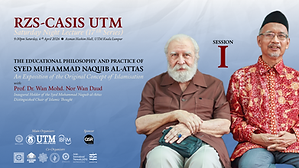
The Educational Philosophy and Practice of
Syed Muhammad Naquib Al-Attas:
An Exposition of the Original Concept of Islamization
SESSION 01
4th April 2026
This lecture serves as a profound tribute to the life and intellectual legacy of Professor Syed Muhammad Naquib al-Attas. Prof. Dr. Wan Mohd Nor Wan Daud emphasizes that the "Saturday Night Lecture" series is not a casual engagement but a rigorous intellectual banquet requiring deep commitment to an integrated worldview. Prof. Dr. Wan argues that Al-Attas was unique among modern scholars for identifying the "root tragedy" of the Muslim world as the corruption of knowledge and the loss of adab, rather than mere political or economic failure. By framing education as the recognition of the proper place of things, the lecture advocates for a "metaphysics of Islam" that can bridge sectarian divides and confront the challenges of Western secularism. Ultimately, the discourse functions as a call to action for a new generation to preserve this coherent framework of thought against the rising tide of intellectual confusion and "false leaders."

The Educational Philosophy and Practice of
Syed Muhammad Naquib Al-Attas:
An Exposition of the Original Concept of Islamization
SESSION 02
18th April 2026
This session is on the metaphysical worldview of Islam, specifically through the philosophical framework of Professor Dr. Syed Muhammad Naquib al-Attas. The discourse establishes that a correct worldview is not merely an academic exercise but a foundational obligation for every Muslim, as it provides the essential vision of truth and reality that governs both the soul and external actions. By contrasting metaphysics in Islam with the limitations of secular philosophies and modern "dataism," Prof. Wan argues that true knowledge must be rooted in revelation, sound reason, and sincere experience. Structurally, the discourse moves from theoretical definitions to practical applications, emphasizing that a teacher's integrity and ethical discipline (adab) are inseparable from the knowledge they impart. The narrative highlights that this worldview is metaphysical because it encompasses both the visible world and the more fundamental unseen realities, centered on the nature of God. Ultimately, the lecture serves as an exhortation for believers to cultivate a sincere consciousness of the Divine, which acts as a living guide for personal conduct, social justice, and the preservation of Islamic identity in a confusing modern age.
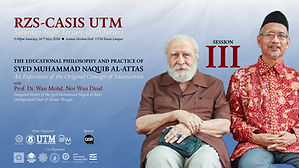
The Educational Philosophy and Practice of
Syed Muhammad Naquib Al-Attas:
An Exposition of the Original Concept of Islamization
SESSION 03
16th May 2026
This lecture examines the educational philosophy of Syed Muhammad Naquib al-Attas, identifying the vicious cycle of decline in the Muslim world as a consequence of confusion and error in knowledge. The political and economic struggles are merely symptoms of a deeper "loss of adab," where the inability to recognize true expertise leads to the rise of false leadership in all fields of society. To break this cycle, the restoration of adab is a prerequisite for proper education, defined as the discipline of the soul that allows one to recognize the correct places and roles of things. Central to this vision is a rejection of sophism and relativism, asserting instead that human beings can attain certainty in knowledge through a worldview where reason and revelation are harmoniously integrated. Ultimately, the discourse presents education not as a tool for material gain, but as a transformative process intended to produce good human beings who understand their spiritual and social responsibilities.

The Educational Philosophy and Practice of
Syed Muhammad Naquib Al-Attas:
An Exposition of the Original Concept of Islamization
SESSION 04
30th May 2026
This session offers a profound exploration of the Islamic philosophy of knowledge, primarily centered on the work of Professor Syed Muhammad Naquib al-Attas. Contemporary society is suffering from a crisis of truth characterized by confusion and the loss of the ability to define fundamental concepts. Knowledge has a dual definition: as a divine gift where meaning arrives in the soul, and as a human endeavor where the soul arrives at meaning. This process is ultimately intended to lead an individual to recognize the proper place of God within the order of existence, distinguishing true knowledge from mere information or technical skill. By detailing various channels of certainty—such as sound senses, intellect, and authentic reports—the discourse serves as a call for intellectual and spiritual clarity to overcome modern skepticism and relativism.
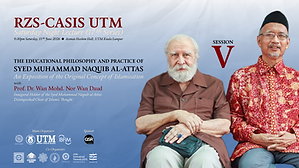
The Educational Philosophy and Practice of
Syed Muhammad Naquib Al-Attas:
An Exposition of the Original Concept of Islamization
SESSION 05
13th June 2026
This discourse centres on the transition from viewing education as mere instruction to the profound concept of ta’dib, which represents the progressive instilling of adab—the discipline of body, mind, and soul—into a student. Central to this philosophy is the definition of knowledge as the arrival of meaning in the soul, where meaning is understood as the recognition of the proper place of things within the created order, ultimately leading to the acknowledgment of Allah’s rightful place in existence. Professor Wan critiques the contemporary loss of adab, arguing that the modern reduction of education to technical training or "integration" reflects a confusion of definitions and a departure from the authentic worldview of Islam. By advocating for a return to these traditional intellectual roots, the lecture emphasizes that true education must cultivate wisdom and justice to rectify the systematic de-sacralization of knowledge in the modern world.

The Educational Philosophy and Practice of
Syed Muhammad Naquib Al-Attas:
An Exposition of the Original Concept of Islamization
SESSION 06
27th June 2026
In this lecture, Professor Dr. Wan Mohd Nor Wan Daud explores the educational philosophy of Syed Muhammad Naquib al-Attas, specifically advocating for the Islamization of knowledge as a dynamic process rather than a failed historical experiment. He argues that higher education must be the strategic starting point for reform because universities shape the future leaders, teachers, and parents who define a society's worldview. Central to this vision is a sophisticated understanding of fard ayn, which should not be reduced to basic rituals for children but expanded into a lifelong, intellectually mature framework that governs ethical conduct and accountability in professional fields. By prioritizing the clarification of key concepts and the restoration of adab—the right action born of right knowledge—the lecture posits that true educational reform serves to produce "civilized" human beings capable of navigating modern challenges like artificial intelligence and secularization. Ultimately, the discourse emphasizes that the goal of learning is to mirror the prophetic model, transforming the individual's soul to ensure that specialized expertise is always tempered by spiritual wisdom.
SATURDAY NIGHT LECTURE
Distinguished Visiting Scholar Series


01 Are We Living the Worldview of Islam?

02 Are We Living the Worldview of Islam?

Are We Living the Worldview of Islam?
SESSION 01
18th July 2026
In this first session, Dr. Syed Ali Tawfik al-Attas explores whether contemporary Muslims are genuinely living the worldview of Islam or if they have succumbed to an inferiority complex by imitating Western secular paradigms. By drawing a parallel between the Quranic story of the golden calf and modern society’s obsession with technology, artificial intelligence, and Bitcoin, he argues that Muslims have traded their intellectual heritage for a "here and now" philosophy known as secularization. He critiques the current state of leadership and education, noting that the focus has shifted toward mere infrastructure and Westernized curricula rather than the development of the individual and the pursuit of beneficial knowledge. Ultimately, the lecture serves as a call to reclaim a distinct identity by aligning daily actions—from linguistic precision to social justice—with the integrated, ethical framework of the worldview of Islam.

Are We Living the Worldview of Islam?
SESSION 02
1st August 2026
This lecture explores whether contemporary Muslims are truly living according to the worldview of Islam, which is defined as a vision of reality and truth grounded in revealed knowledge rather than speculative philosophy. This worldview is complete and unchanging, yet Muslims currently face a crisis of definition because they have lost the ability to apply logic and reason to distinguish between beneficial knowledge and falsehood. This intellectual confusion has led to the uncritical adoption of Western frameworks, specifically the conflation of science with technology and the reduction of justice to mere administrative law. By emphasizing the linguistic roots of terms like din and tamaddun, Dr. Syed Ali Tawfik al-Attas illustrates that true civilization requires a sense of indebtedness to the Creator and an education system that prioritizes metaphysical certainty. Ultimately, the lecture serves as a call to intellectual bravery, urging Muslims to maintain their ontological integrity rather than compromising their values to suit the prevailing trends of a world-centered age.